Before Google Knew Everything: What We Actually Lost When Algorithms Replaced AOL Keywords
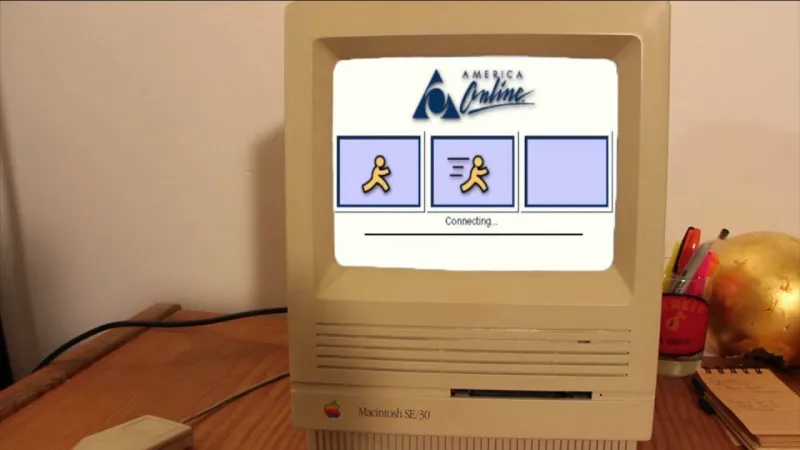
Photo: vintage AOL CD-ROM disc 1990s internet dial-up connection startup screen, via i.ytimg.com
Type a keyword into Google today and within a fraction of a second you'll get millions of results, ranked by an algorithm so complex that even the people who built it can't fully explain every decision it makes. It's an engineering marvel, no question. But spend a few minutes with an old AOL CD-ROM, or dig through a Wayback Machine snapshot of Yahoo's original directory, and you start to notice something: the old way of finding things online had a personality the modern web has completely abandoned.
This isn't a nostalgia piece, exactly. It's more of an autopsy.
The Keyword Era: Somebody Decided What Mattered
For millions of Americans, "the internet" from roughly 1994 to 2002 meant America Online. And AOL's signature trick — the AOL Keyword — was deceptively simple. You'd press Ctrl+K, type something like WEATHER or MOVIES or HEALTH, and get taken directly to a curated section of AOL's walled garden. No searching required. No ambiguity.
Those keywords weren't generated by an algorithm. A human being at AOL had approved them, organized them, and decided what they pointed to. In a way, it was the internet filtered through an editorial sensibility — more like a magazine than a search engine. You didn't ask AOL a question. You navigated AOL's idea of what the internet should look like.
Yahoo operated similarly in its early years. The original Yahoo directory was literally a hand-curated list of websites, organized into categories by actual human editors. Finding a site in Yahoo's directory meant someone had reviewed it and placed it somewhere meaningful. That's a radically different philosophy from how we find things today.
The Open Directory Project (DMOZ) took it even further, crowdsourcing the curation to volunteer editors who maintained categories like passionate librarians tending their sections of a vast reference room.
Then Google Arrived and Changed the Question
When Google launched in 1998, it did something conceptually different from its predecessors. Rather than organizing the web according to human editorial judgment, it let the web's own link structure determine relevance. PageRank treated links as votes, and the sites with the most authoritative votes floated to the top.
The results were genuinely better — faster, more comprehensive, less constrained by whatever a Yahoo editor happened to know about a given subject. By the early 2000s, the comparison wasn't even close. Google found things that curated directories simply couldn't.
But "better at finding things" and "better for how people experience information" aren't necessarily the same sentence.
The Serendipity Problem
Here's what the old approach had that the new one quietly killed: serendipitous discovery.
Browsing Yahoo's directory in 1997 was an experience closer to wandering through a library than querying a database. You'd go looking for information about astronomy and end up clicking through to a page about ancient navigation techniques, then to a hobbyist's guide to building telescopes, then to a forum where amateur astronomers were trading observations. None of that was "optimized" for you. It just happened, because the structure invited wandering.
Google, by design, answers the question you asked. It's extraordinarily good at that. But it has little interest in the questions adjacent to the one you asked, the tangents that might actually change your thinking, the rabbit holes that don't fit neatly into a search query. The algorithm serves your stated intent. It doesn't serve your latent curiosity.
Researchers who study information behavior have a term for this: the difference between searching and browsing. We've built a world-class searching infrastructure while largely letting browsing atrophy.
SEO: The Algorithm's Unintended Offspring
The other thing that happened when Google took over is that an entire industry emerged dedicated to gaming its rankings. Search Engine Optimization — SEO — started as a reasonable effort to help good websites get found. It evolved into something considerably more complicated.
By the 2010s, vast swaths of the web were being written not for human readers but for Google's crawlers. Articles padded to hit word counts that algorithms supposedly rewarded. Headlines engineered to match predicted search queries rather than to communicate clearly. Content farms producing thousands of articles on trending topics, optimized for ranking rather than accuracy or depth.
The AOL keyword system, for all its limitations, was resistant to this kind of manipulation almost by definition. If a human editor had to approve what a keyword pointed to, you couldn't game the system at scale. The walled garden kept the weeds out in ways the open web couldn't.
None of this is to say the curated model was superior overall — it clearly wasn't scalable, and it gave enormous power to a small number of gatekeepers to decide what information was "legitimate." That's its own serious problem. But the open web's solution created a different set of serious problems, and we're still working through them.
What the Walled Garden Got Right
There's a reason the phrase "walled garden" is usually used as a criticism, and it's a fair one. AOL's version of the internet was heavily corporate, aggressively monetized, and deliberately limited in scope. It was the internet with the rough edges sanded off — which meant a lot of the interesting stuff got sanded off too.
But consider what that structure also provided: a coherent sense of place. AOL users had a shared experience. When you said "go to AOL keyword: NEWS," everyone knew what you were talking about. There was a common frame of reference, a shared map of the territory.
The modern web has no such map. Every user's Google results are personalized, filtered, and increasingly shaped by their own prior behavior. Two people searching the same term can get meaningfully different results. That personalization is often presented as a benefit — and in narrow terms, it is. But it also means we're increasingly navigating different versions of the same internet, a fragmentation that has consequences that go well beyond which websites show up first.
Finding Things vs. Understanding Things
Maybe the deepest question the AOL-to-Google transition raises is this: what is search actually for?
If the goal is to retrieve a specific piece of information as efficiently as possible, Google is an extraordinary tool — arguably one of the most impressive ever built. But if the goal is to develop genuine understanding of a subject, to encounter ideas you didn't know you were looking for, to be surprised and challenged and redirected by the process of inquiry itself, then efficiency might actually work against you.
The old directories and keyword systems were slow and limited and often wrong. But they were also, in their clunky way, educational. You had to understand how information was organized to navigate them effectively. That friction built a kind of literacy.
We traded that friction for speed, and we got something genuinely valuable in return. But we should at least be honest that a trade happened — and that not everything on the other side of that ledger was worthless.